 Michael Chase
Can you build a stylish wardrobe with only $100 to spend each month? Yes, but not if you shop every time a new trend appears. The winning strategy is slower, stricter, and a lot less exciting at first.
A $100 budget works when every purchase has a job. You need clothes that fit your real week, repeat with several outfits, and survive regular washing. The goal is not to own more. The goal is to remove the daily problem of having nothing that works.
How Should You Split a $100 Wardrobe Budget?
My recommendation: spend the first three months building a reliable base, not chasing personality pieces. A wardrobe with one striking jacket and no usable trousers is not stylish. It is unfinished.
Use four spending buckets
Divide the monthly budget before you open a shopping app. Put $45 toward foundation pieces, $25 toward secondhand finds, $20 into a rollover fund, and $10 toward maintenance. The rollover fund matters because good coats, leather shoes, tailoring, and quality denim rarely fit inside one month. Saving $20 for five months gives you $100 for one deliberate purchase.
| Budget bucket | Monthly amount | What it covers | Rule |
|---|---|---|---|
| Foundation | $45 | Tops, trousers, skirts, or knitwear | Buy only pieces that make at least three outfits |
| Secondhand | $25 | Thrifted denim, jackets, bags, and dresses | Inspect fabric, seams, lining, and stains first |
| Rollover fund | $20 | Coats, boots, tailoring, and higher-cost staples | Do not raid it for impulse purchases |
| Maintenance | $10 | Buttons, hems, stain treatment, and shoe care | Repair before replacing |
Let the calendar control the purchase
Buy according to the next six weeks of your life. If a wedding is coming, save for the dress or tailoring. If winter begins soon, prioritize a warm layer. If your work schedule changed, buy the piece that solves the new dress code. A random sale item is not a bargain if it stays in the closet.
The first month may produce only two basic tops. That is fine. You are creating combinations. A neutral top that works with jeans, trousers, and a skirt is worth more than a dramatic item that works once.
What Is the Smartest Way to Shop on a Small Budget?

Use a shopping process that creates friction. Friction stops a $17 mistake from stealing money from a $100 purchase you actually need.
Follow this five-step buying process
- Audit your closet. Write down the five items you wear most, the three outfits you avoid, and the category causing the problem. “I need clothes” is too vague. “I need black trousers that fit at the waist and work with my office shoes” is useful.
- Set a gap list. Keep no more than three active wardrobe gaps. Rank them by frequency. A shirt worn twice a week beats a party top worn twice a year.
- Check your outfit math. Before buying, name three complete outfits using clothes you already own. Include shoes and an outer layer. If you cannot do this in one minute, leave the item.
- Measure instead of guessing. Compare garment measurements with a piece that fits. Check waist, hip, rise, inseam, shoulder width, and sleeve length. Online size labels are inconsistent. Numbers are safer.
- Wait 72 hours. Put the item on a note with its price, fabric, and possible outfits. If you still want it after three days and it fills a ranked gap, buy it.
Use sales as a timing tool
Sales should lower the cost of a planned item. They should not decide what you buy. Mark the date you expect to need something, then watch prices for two or three weeks. Search resale platforms after checking the original garment measurements. A used item with a missing button or weak elastic may cost more after repairs than a new one.
Set a hard monthly limit on delivery fees too. Three separate $8 shipping charges turn a $76 clothing budget into $52. Combine orders, shop locally, or wait until the cart contains a purchase you already approved.
Which Affordable Pieces Deserve the Most Money?
The best budget wardrobe is not built from the cheapest clothes. It is built from pieces with high wear counts. A $25 top worn 30 times costs about 83 cents per wear. A $12 top worn once costs $12 per wear.
Compare cost, repeat value, and risk
| Piece | Typical price | Best use | Verdict |
|---|---|---|---|
| Uniqlo Supima Cotton Crew Neck T-Shirt | $24.90 | Clean everyday base layer | Best first-month top because it works under jackets and knitwear |
| Levi’s 501 Original Jeans | About $79.50 | High-rotation casual outfits | Buy only after trying the rise and waist; denim fit is the risk |
| J.Crew Factory Vintage Cotton T-Shirt | About $19.50 | Color and weekend outfits | Good second top, but buy one strong color instead of three weak ones |
| Vans Old Skool | About $75 | Casual outfits and travel | Worth saving for if you need one versatile sneaker |
| Quince Mongolian Cashmere Crewneck | About $100 | Polished cold-weather layering | Use the rollover fund; do not squeeze it into a random month |
Spend more on fit and fabric than novelty
For most people, the first serious purchase should be trousers, jeans, or shoes because those categories control the shape of an outfit. A thin top can still look neat if the pants fit well and the shoes look cared for. The reverse is harder.
Check fiber content, but do not treat it as a style guarantee. Cotton can twist after washing. Linen wrinkles quickly. Polyester can hold odor. Wool can pill. Read the care label and inspect the garment under bright light. Look for even stitching, stable seams, a smooth zipper, and pockets that lie flat.
Know when the cheaper option loses
Do not buy inexpensive shoes for a job that requires daily walking if the sole feels stiff or the heel slips. Do not buy trousers that need constant tugging. Do not buy a cashmere sweater if you will avoid wearing it because hand washing feels like a chore. The best item is the one you will actually reach for.
My clear pick for a first clothing purchase is a well-fitting pair of trousers or jeans, followed by a neutral T-shirt. The Uniqlo Supima Cotton T-Shirt is the safer low-cost start; Levi’s 501 jeans are the better long-term buy only when the fit is right.
What Makes a Low-Budget Wardrobe Look Expensive?
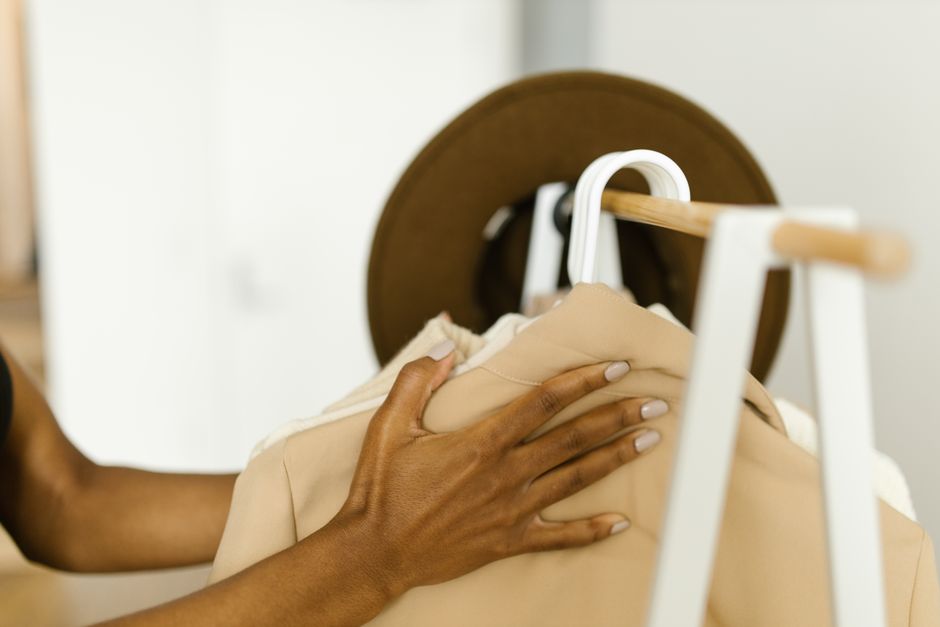
Price is not the main signal people read. They notice proportion, condition, color, and whether the outfit looks intentional. A $40 outfit can look sharper than a $250 outfit when the clothes sit correctly on the body.
Build a repeatable color system
Choose two base colors, two supporting neutrals, and one accent. For example, use navy and black as bases, cream and denim as supporting neutrals, and burgundy as the accent. This gives you a visible system without forcing every piece into a capsule wardrobe.
Use the 60-30-10 rule for an easy outfit: roughly 60 percent base color, 30 percent secondary color, and 10 percent accent. The numbers do not need to be exact. A navy outfit with cream shoes and a burgundy bag follows the idea. So does denim with a white shirt and a red scarf.
Fix proportion before buying anything else
Try three simple changes. Tuck a loose top into higher-rise bottoms. Push or tailor sleeves so the wrist shows. Add a shorter jacket over a long skirt, or a longer layer over a narrow trouser. These moves create shape without spending money.
Most wardrobe frustration comes from proportions that fight each other. Wide trousers with a long, loose top can look heavy. A slim top and a cropped layer usually balance them better. A full skirt may need a closer-fitting top. A boxy jacket often looks cleaner over a straight-leg bottom than over another oversized piece.
Make care part of your style budget
Wash clothes less often when they are not dirty. Air out knitwear. Use cold water, turn dark items inside out, and avoid high heat unless the care label allows it. Steam wrinkles before leaving home. Replace loose buttons quickly. Clean sneakers with a soft brush instead of waiting until they look worn out.
Tailoring is often the highest-return use of $10. A hem, button move, or waist adjustment can turn an almost-right thrift find into a favorite. Do not tailor poor fabric or a garment that pinches across the shoulders. A bad cut cannot be rescued cheaply.
When Should You Stop Shopping for Clothes?

Stop shopping when the next purchase solves a tiny annoyance instead of a real wardrobe gap. The closet should support your life, not become a monthly entertainment bill.
How do you spot a false need?
Ask three questions: Do I already own a similar item? Can I name three outfits today? Would I still want it at full price? If the answer to the first question is yes and the other two answers are no, skip it.
Another warning sign is a purchase that requires two more purchases. A special blouse that needs special trousers, special shoes, and a new bra is not a $25 item. It is the start of a $150 outfit. Buy clothes that connect to the wardrobe you have.
When should you choose secondhand or save instead?
Choose secondhand for structured jackets, natural-fiber sweaters, leather bags, and unusual color. The resale market often gives you better fabric for the same money. Inspect the underarms, collar, cuffs, lining, and inside seams. Walk away from strong odor, moth holes, stretched elastic, or stains that sit across the front.
Save instead of buying now when the item must last for years, needs a precise fit, or protects you from weather. A winter coat, walking boot, or work shoe deserves a larger fund. Buying a weak substitute every season costs more than waiting.
What should the finished monthly plan look like?
Use the first month for one foundation top and one repair. Use the second month for bottoms or a secondhand layer. Use the third month for a rollover purchase only if the first two months created at least six complete outfits. If not, repeat the basics. Your closet is not behind schedule.
| Your problem | Best move | Do not buy |
|---|---|---|
| Nothing matches | Add a neutral foundation piece | Another bright statement item |
| Outfits look sloppy | Tailor, steam, and improve proportions | A larger shopping haul |
| Shoes limit every outfit | Save for one versatile pair | Cheap shoes with poor support |
| You keep repeating one outfit | Buy the missing layer or bottom | A duplicate of the favorite top |
The compressed verdict is simple: spend $45 on useful foundations, save $20 for high-cost gaps, use $25 for carefully checked secondhand pieces, and protect $10 for repairs. For a polished wardrobe, fit and repeat value beat novelty every month.


